Search our web site

Zreče crest Slovene flag

Sedbergh Town Twinning
Christmas in Zreče 2004.


Some of my less active friends are impressed by the nocturnal habits of Howgills Harmony and the Cautley Carollers.

Some of these singers who came with their lanterns to the end of Dowbiggin lane just before Christmas, and then over the fields in the dark for a short concert in the courtyard of Hallbank, even described it as “extreme carolling” and “not dissimilar to the 1812 retreat from Moscow”. And even quipped that we would take the people living at Hallbank by surprise - they would never expect carollers coming at them from this direction.

But the good people of Zreče are made of sterner stuff. We got the bus up to Rogla on Christmas eve, skied until it was dark, and then joined a party of singers with their lanterns for a three hour walk through the mountains.

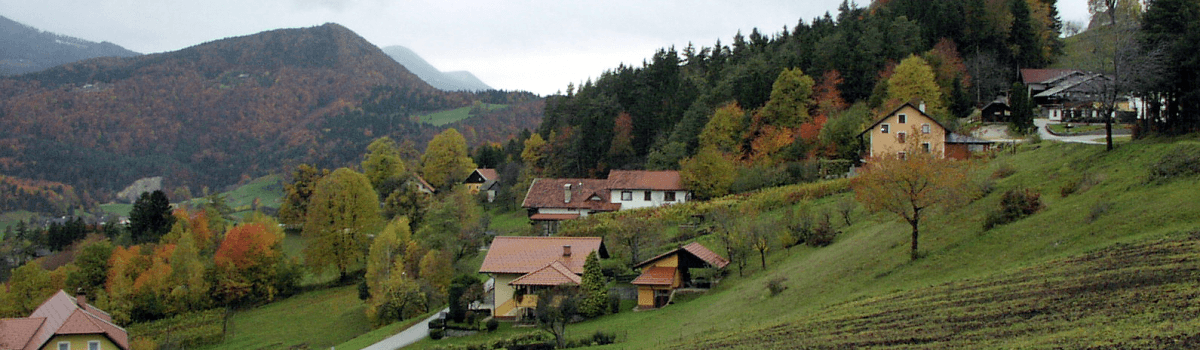
The view from Skomarje to Zreče over the hills

The view from Skomarje to Zreče over the hills

It was stunningly beautiful - the moon shining through on the forest, the distant lights of Zreče thousands of feet below twinkling like earthly stars, and our lanterns bobbing through the woods.

Unlike the Cautley Carollers, our fellow singers on this trip didn't stop to sing but would burst into Slovenian carols whenever the spirit moved. We only stopped for another kind of spirit - the Borovnicevec blueberry brandy which was so popular at the People's Hall party earlier in the year.

As midnight approached, we arrived at Skomarje, a tiny village high in the mountains and were shepherded into their community hall where there were more refreshments until midnight mass in the church.

There were as many people outside as in, and inside only room for half the people to sit. The church is incredibly ornate, little lights twinkling off golden statues, the domed ceiling painted with saints and cherubs, statues and shrines and candles everywhere.

The choir sang from a west gallery behind us - the first carol being Silent Night in Slovenian, and then others including one that Samo Ivacic had sent us called Glej, Zvezdice Bozje. Everyone joined in with the ones they knew - not dissimilar to a carol service with the Cautley Carollers or the Dent Choir. Only here the people who were outside would squeeze inside for a few minutes as others left. Mass was received by a quorum from the group - just a few who were already at the front or brave enough to stuggle through the crowd to get to the priest.

The service over, we wished each other Vesel Borcic - merry Christmas - which I had been wishing people since I arrived. Only now instead of a rather embarrassed silence in reply, we were wished it in return.

“Christmas eve is the special time for Christmas here,” said Alenka who was the only one in our party who spoke English and with typical Slovenian hospitality attached herself to us as our guide. “We decorate our tree, and after midnight mass, Christmas begins.” She had dinner with her family at 2am when she got home.

The following day was similar - only this time we walked up from Zreče with our lanterns to a tiny church on top of a hill overlooking the town. Here were even fewer seats and even more people crushed into the church. Afterwards we talked with the priest who gave us the music for some of the songs so that we can learn them back in Sedbergh.

There followed a party outside with a huge bonfire blazing away while the Vino Kuhano - hot mulled wine - was poured out of urns, and more singing round the fire.

The priest is young - barely thirty - and there is some speculation that this accounts for the large number of young women in the choir. With Christianity banned under communism, it is only recently that new priests have been made, with the consequence that they are all either very young or very old.

The youthfulness of the population is different to Sedbergh, caused mainly by the presence of several factories providing work and allowing young people to stay in the community where they were born.

“But still they go to Brussells thinking things will be better,” says Zdenka who came with the others to Sedbergh and was very helpul in showing around Zreče. “And I tell them: Why go there? There is no work for you, life isn't better there.”

Singing is far more common in Zreče than here. The day after Christmas day - Slovenian independence day - we went to a concert in the town with local groups and choirs. Samo was there with his six voice group DUST - mostly members of his family. His mother is a singing teacher and led one of the other choirs. Each village surrounding the town had a choir which sang, and there were several children's choirs of all ages.

At one point a group of children came in singing, dressed as kings and shepherds, portraying a custom of taking their songs and presents to the homes in their villages to welcome the birth of Christ.

After the concert there was another party at which we were the honoured guests. There was much excitement as people we had met at the nightime services came and greeted us, and there were several people there who had come to Sedbergh including the Mayor, Samo and the women from the Post Office.

And then as we stood around chatting everyone burst into a song in praise of wine, followed by another about life in Zreče.

“Look at us, we aren't interested in working, only in singing and partying together,” joked one of the Slovenians. “That's why we voted for you,” I replied - though of course we both knew how hard they do work. There is no national holiday in Slovenia if Christmas falls on the weekend - although the factories were closed until the new year.

On our first evening in Zreče we had wandered around the town, and after joining a huge party in the town hall, with polka dancing a band playing their traditional music, (the following day we found out that we had accidentally stumbled into the works do of one of one of the factories) we went to little wooden bar looking not unlike a bus shelter where we toasted Slovenia and the good people of Zreče.

Although the bar was almost full, the only woman was serving the drinks. And being the only young person in the room, she was also the only one who spoke English.

There is a myth that everyone on the continent speaks English. In this part of Slovenia, German is the second language, it's only recently that English has been taught in schools. So George Handley's Slovenian phrase book was very handy with greetings like: “Dober vecher” - good evening; “Hvaala lepa” - thankyou very much, and “kako ste?” - how are you.

What I liked about the singing in Zreče is that no one is embarrassed to burst into song whenever they feel moved - which is most of the time. But unlike the concert where the standard of music was extraordinarily high, in the bar the singing was somewhat less tuneful.

When one of them started singing a Croatian song, Plovi Barko, I was able to join them as our group in Sedbergh sings this. There then followed a fierce debate between those who thought that this was a good song which should be sung often, and those who thought that as it comes from Croatia, with whom Slovenia has a territorial dispute over the ownership of some of the coast, it was …. A rather rude word in Slovenian.

There then followed the drunken singing of the national anthem and afterwards much discussion about the former Yugoslavia and how close they should be with the rest of Europe - one Europhile even introduced me to another rude word, which he used to describe how he felt about Slovenia. He was very much an exception - all the people we met were extraordinarily proud of their country and their town. There is even an amusing pop song called “Made in Slovenia” which combines national pride with a description of national sexual mores.

Although we were often able to find people to translate for us, we tried as much as possible to speak Slovene so as not to appear arrogant. But sometimes our phrase book was less than helpful. The Berlitz book translates “I have enjoyed it, thankyou,” as “temelu nam je, hvaala.” So, having a hitched a lift down from Rogla to Zreče we thanked our driver with this phrase. Later on, with much laughter from the Slovenians, we discovered that it meant “We have enjoyed the meal.” The driver must have though we had been eating his back seat.

It did however come in handy when we walked back to Skomarje to see it in the daylight and were invited in to have “Christmas tea” - hot, sweet and flavoured with oranges, cloves and rum - with a couple who live there. We exhausted the entire section called: “Making friends.” “How long have you lived here?” “What is you name?” “What work do you do?” Though we were not altogether clear what the responses were. The only phrase we didn't use was: “Why are you laughing? Is my Slovenian that bad?”

Just before we left we were invited to a meeting with the mayor - I think our special status was as the first tourists from Sedbergh, though I suspect they find an excuse to treat everyone who goes to Zreče as being special. The mayor gave us a talk about the town and we made several toasts to our respective towns. Unused to drinking Blueberry brandy at 10am, I soon became even more expansive than usual and our toasts included “the Brotherhood of Man,” “the international language of music,” and “world peace.”

Only some of it was inspired by the brandy. There is something very uplifting about these good people and the way they have kept the old traditions of hospitality and welcome, and a love of song which does connect you with a feeling of humanity.

Perhaps it is as simple as a recognition that as you find bridges between two different countries, it becomes easier to find ways over the much bigger bridges between the differences in our own community. And that connectedness is what elevates us as human beings.

David Burbidge